TPLO Surgery

With a renowned board-certified surgeon.

Is your dog limping on his or her back leg? If you're dog is limping it may very well be the cranial cruciate ligament (CCL) that is causing the problem. In fact, CCL rupture is the most common cause of hind limb lameness in dogs. Fortunately, with proper diagnosis and treatment, dogs with CCL rupture can recover and go on to live an active, normal life. Tibial plateau leveling osteotomy (TPLO) is the optimal and preferred treatment for CCL rupture because it offers immediate stability to the joint and provides the best long-term prognosis.
Open Positions

Anatomy of the canine stifle

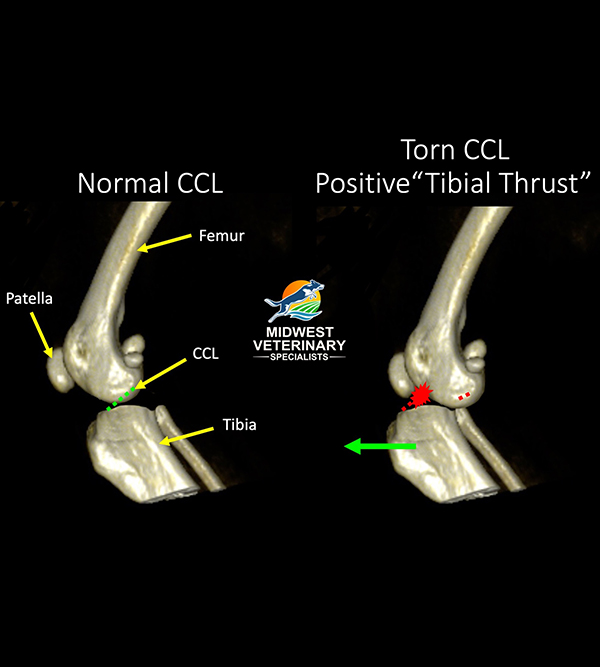
Your dog’s stifles (i.e., knee joints) absorb a lot of impact as they run, jump, and play. To understand cranial cruciate ligament rupture, you must first understand the components of the stifle joint. This stifle is composed of the femur (i.e., thigh bone), tibia (i.e., shin bone), and patella (i.e., kneecap). Four ligaments—the cranial cruciate, caudal cruciate, medial collateral, and lateral collateral ligaments—are primarily responsible for stabilizing the stifle. The medial and lateral menisci act as cushions between the femur and tibia, and help provide congruency and further stabilize the joint.
Canine cranial cruciate ligament

The canine cranial cruciate ligament (CCL), which is the anatomical equivalent to the human anterior cruciate ligament (ACL), has three functions:

  • It limits hyperextension of the stifle
  • It limits internal rotation of the tibia, relative to the femur
  • It prevents front-to-back sliding motion (i.e., drawer motion) of the tibia relative  to the femur.

Canine Cranial Cruciate Ligament Explained

From CCL disease information to diagnosis and treatments.

CCL Disease

What is cranial cruciate ligament disease? Learn more about CCL disease, the risk factors and pain resulting from CCL disease.

CCL Rupture Diagnosis

There are several test to assess your dog for CCL rupture. Learn more about early signs and diagnostic testing.

CCL Treatment Options

CCL disease is manageable through medical and surgical treatments. Learn more about available options for managing CCL disease.

Locking TPLO Plates & Screws TPLO has been successfully performed for more than 25 years, with  more than 200 supporting research studies. The TPLO surgery involves making a cylindrical cut at the top of the tibia, and rotating the top portion to reduce the tibial plateau angle (TPA) to approximately 5° to 6°. The bone segment is held in place in this new position with a plate and screws. The goals of rotating and “leveling” the tibial plateau is to prevent the femur from sliding down the slope of the tibia and to stabilize the stifle. At Midwest Veterinary Specialists, we use only the latest technology called locking TPLO plates & screws, where the screws lock into both the bone plate and the bone. This creates a stronger construct that is less likely to break or become loose. This is important because the bone plate and screws are necessary to hold the bone in the correct position for the first eight weeks after surgery. Once the bone has healed, the plate and screws are no longer necessary, but they are typically left in place forever, unless a problem, such as infection or irritation, develops. Fortunately, implant removal is only necessary in approximately 3% of TPLO patients. At Midwest Veterinary Specialists, our TPLO plates are coated with a novel silver ion coating called HyProtect, which has been shown to decrease the chance of infection post-operatively.  Tibial plateau leveling osteotomy: The best choice for most dogs

Improved outcomes Despite TPLO’s perceived invasiveness, most dogs begin bearing weight on the operated leg within a couple of days after surgery and limb function steadily improves. This rapid, comfortable return to function makes TPLO preferable to the lateral suture technique. Although the lateral suture technique can be effective for smaller dogs, research supports performing TPLO in small-breed dogs because they have better outcomes. Regardless of dog size, evidence-based literature shows improved outcomes with TPLO over other commonly performed surgical procedures. In fact, Dr. Bergh performed and published a scientific systematic review of all of the literature published on surgical techniques for CCL rupture in dogs, and found that the TPLO was the only procedure that consistently allowed dogs to return to normal function and activity. Additional studies after that report have supported her findings. Open Positions

Long, Happier Life TPLO provides a good to excellent outcome in 90% to 95% or more of patients. This means that most dogs are able to return to the level of activity that they had before you noticed that there was a problem with their leg - including playing frisbee and going to the dog park! Less commonly, your pet may be sore for a short time after heavy activity, and may require anti-inflammatory medication. For one reason or another, 5% to 10% of patients will not return to a desired level of function, and may need additional rehabilitation therapy or other therapeutics. It is important to note that even if your pet suffers a complication or setback, such as an infection or a post-op meniscal tear they can still have a good to excellent long-term outcome—early identification and treatment of the problem is key.

How The TPLO Surgery Works

TPLO Post-operative Information Explained

What to know after Tibial Plateau Leveling Osteotomy.

Post-TPLO Recovery

What to expect and what to do during the first 8 weeks of recovery.

Post-operative Lameness

Understanding lameness after your dog has TPLO. Learn more about early signs and symptoms of lameness.

Arthritis Management

Explore different arthritis management techniques and treatments to help your dog.